Newsletter - July 26th 2026
Disclaimer: this will be a shit article. I didn't write for months and I have to get back into the habit again.
It just sucks when restarting. What's important? Is it too much writing? Is there a conclusion?
In this article, not drawing in a lot of conclusions. I just try to get back into the habit again (this whole turn all the good stuff is into a habit isn't a meme actually)
Another Art of the Deal Master Class
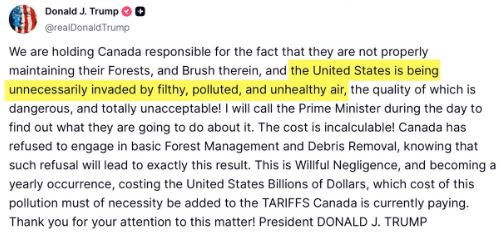
On July 20th, Trump said something that sounded like a joke. He said that smoke from Canadian wildfires was drifting south and described the U.S. being "unnecessarily invaded by filth, polluted and unhealthy air"
In 30 days, on August 19th, the U.S. would begin taxing a long list of Canadian goods under section 338 of the Tariff Act of 1930.
Most people (including me as a non-U.S. citizen) have never heard of Section 338, as it has sat mostly untouched since the Hoover era. Basically, the president can slap up to 50% duties on that country's goods if he decides that the country has been treating American exporters unfairly.
From my understanding, he can ban goods from entering at all without declaring some emergency. He also doesn't have to build a national security case. He can say the word.
1 day later, American and Mexican negotiators went and sat down in Mexico City for their bilateral talks. Canada didn't have a seat at the table, although it's about the tariffs placed upon them (do I say that right?).
The white house gave 3 reasons (none of them is about the smoke)
- Cheese/dairy. Canada limits how much foreign cheese can come in duty-free. There's a certain "allowance" that goes through a quota system. Canada's trade deal with Europe allows retailers to hold and use those allowances. With the U.S., they can't; the product is the same,e but the rules are different, and so Americans end up with the short end of the stick. Washington calls this discrimination.
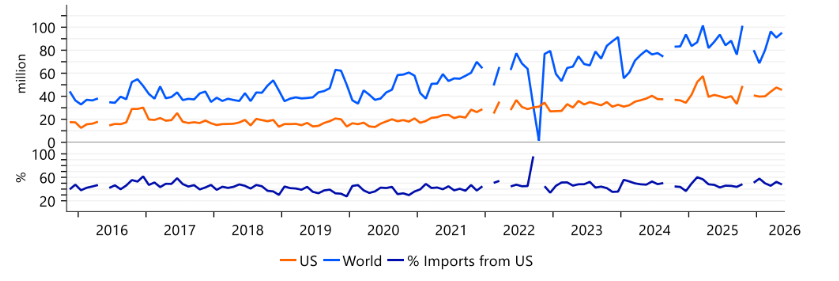
- Alcohol. In March 2025, after Trump's first round of tariffs, provincial liquor boards in Ontario and Quebec pulled American bottles off the shelves entirely. Wine from Chile and Australia stayed while Bourbon from Kentucky did not. So the retaliation from the first round is now the justification for the next round of tariffs.
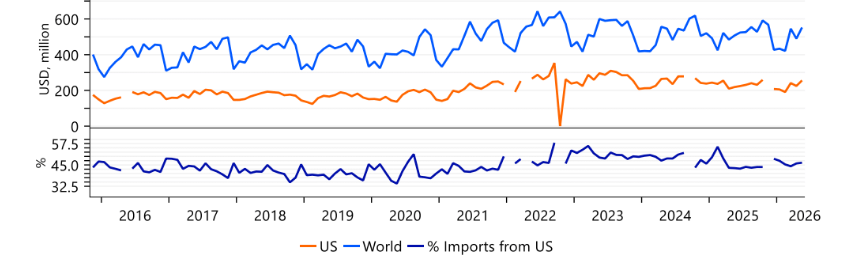
- Cars/vehicles. Since April 2025, Canada has imposed a 25% tariff on American vehicles that don't meet USMCA content rules, with company-by-company quota structures, uhm, to be more specific, "company-specific tariff-rate quotas (TRQs)". So the argument here is to punish automakers who moved production south.
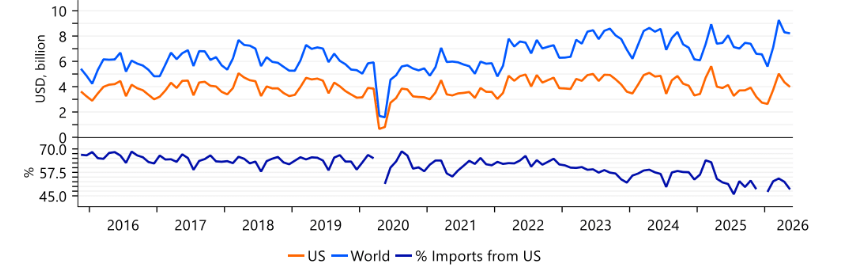
While the list is about cheese, alcohol, and cars, the actual tariffs list runs to more than 400 product codes (HS codes), and there aren't exemptions under the USMCA this time. When added up, it covers 5.8% of what Canada sells to the U.S.
Canada sends somewhere between 80-90% of its honey to the U.S., and that's the market; there's no second-best buyer. If you look at it from the other direction, the picture flips. Only 1/10th of the honey Americans eat comes from Canada, while the rest arrives from everywhere else.
So a tariff on Canadian honey barely registers in an American kitchen, while it does hurt a lot for the Canadians. Repeat this logic across 400 product lines and what we get is a one hell of an engineered policy.
Hurt as little at home, hurt as much as possible over there. Let Mark Carney do the arithmetic.
What's my point? Or what did I want to explain? Tariffs don't have to be collected to work. They have to be believable, and the calendar has to keep ticking.
Carney's response was noticeably unrattled. Canada wants an agreement the day after proclamations were signed. He also made clear the liquor bans come off only as part of the deal (not before one).
These tariffs slip into a limbo if the talks go reasonably well. Delayed, postponed, and/or never quite arriving. A formal cancellation is less likely because, oh well, politics, I guess. A threat you've withdrawn is a threat you no longer own, and reinstating one takes time.
Canadian negotiators now have to spend the next month negotiating about tariffs that may never take effect (section 338 tariffs) while the section 232 tariffs (already in place on steel, aluminum, autos, etc) already damage their economy in the meantime.
Canada's negotiators only have so many hours and so much political capital,l and they're now spending all of it on the hypothetical fire rather than the one that's already burning.
Canadian dollar
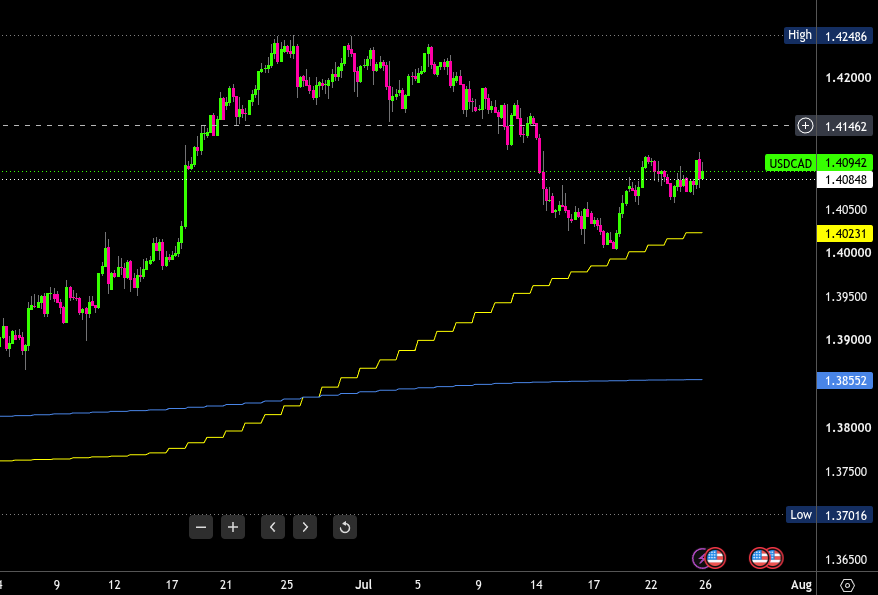
When Trump announced the tariffs, CAD weakened (obviously). USD/CAD went from 1.40 to 1.41. Keep in mind, the denominator here is CAD. So the bad news did hurt CA, D and it was a big move.
Price approached the 50-day moving average and also bounced from there as the bad news arrived.
Currency options are an insurance (using the term loosely here). With a volatile move,d premiums go up, while in quiet times, premiums usually drift down.
On this one, it plots the cost of protection at different distances into the future. The line climbs steadily. Protection for the next week is cheap. Protection for the next summer costs more.
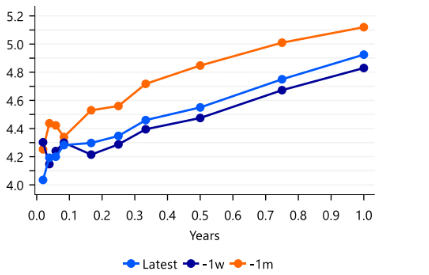
If traders genuinely believed tariffs were about to hit 400 categories of Canadian goods in 3 weeks, near-term protection would be the expensive part. Everyone would crowd into August, and nobody would care much about next April, which is what happened in 2025 during the first tariff round, as the curve inverted as short-dated protection got bid while the long-dated stayed calm.
Volatility can pick up on more announcements and more headlines, or if talks go badly. Expecting a floor at 1.40 and most of its time spent around 1.42 into the end of the year. Bank of Canada pat: still 2.25% as terminal rate (the level they expect rates to settle at once the cutting cycle is done).
Another Recap
The first escalation between Iran and the U.S. sent oil prices higher and revived fears that inflation could make that comeback. Central bank expectations shifted, and Rates and FX vol firmed as the market contemplated a world in which the Fed might have to stay restrictive for longer. (This faded away pretty quickly)
Another ceasefire discussion appeared, then another, and then another. Oil began to bleed lower. Softer U.S. inflation data further reduced the fear of additional Fed hikes. Interest-rate and currency volatility collapsed.
Everyone got scared in the spring about inflation making a comeback and central banks possibly having to hike rates again. A panic that lasted about 6 weeks before fading away.
The first was a notable unwind of steepener positions, which flattened the curve. Oh, and basically a steepener is a bet that the gap between the long-term and short-term interest rates will widen. You can hold it by owning, e.g., short-dated bonds and being short long-dated bonds. Second was rebuilding short positions in short-term rate futures.
CTA's rebuilt very large short positions in short-term interest rate futures, meaning they were positioned for higher short-term yields and lower bond prices and rate cuts.
Brent crude climbed back to early June levels. The U.S. has widened the scope of its overnight airstrike on Iran. Iranian missiles have been fired at American bases in Kuwait, Bahrain and Jordan. EU naval forces raised the threat level in the northern Red Sea for ships linked to the U.S., Saudi Arabia and Israel.
Diplomatic channels between Washington and Tehran have gone quiet (reportedly), and Trump said Iranian power plants are now legitimate targets.
The obvious reading one can get out of this is that oil goes up when supply is threatened. The oil price is not the story at all. It is the trigger for something that runs through every other market.
Start with what expensive oil does to inflation. Fuel feeds into freight, freight feeds into the price of everything shipped. A sustained crude rally forces investors to raise the odds they assign to an inflation case they had been treating as unlikely (the tail).
Higher expected inflation means higher expected interest rates, and here is where it stops being an energy story. What moves is not just the level of rates but the uncertainty around them. The uncertainty can be quantified as rate volatility and is the input that prices interest rate options.
In a sense, all assets are short-rate vol. Discount any long-lived asset, and its value depends on the rate used to discount it. Widen the uncertainty around that rate and the asset gets marked down, no matter what its underlying business is doing.
Crude goes up, inflation tail gets repriced, hike expectations firm, rate vol rises, and every asset with negative exposure to it comes under pressure. If crude keeps climbing, the sequence runs again.
Different this time?
Markets have already been through this in 2026. A version of the same shock hit in the spring, when the iran conflict sent oil up 50% from the start of the war and the U.S. Treasury borrowing advisory committee described the result as a significant hawkish repricing of central bank policy, worst in Europe.
Central banks talked tough without actually moving. Federal Reserve held, the Bank of England held more hawkishly than expected, the ECB signaled it would act if energy went further, and the Bank of Japan board members dissented in favor of a hike.
Then oil fell back, and all the panic that was created just vanished. The positioning, however, did not dissolve with it.
Steepener trades, bets that the gap between long and short rates would widen, were unwound at scale, which in turn flattened the curve. Short positions in short-term rate futures, which profit when the market prices more hikes, were rebuilt.
CTAs are again maximally short those STIR (short-term interest rate futures). Rates are now positioned for hawkishness rather than braced against it.
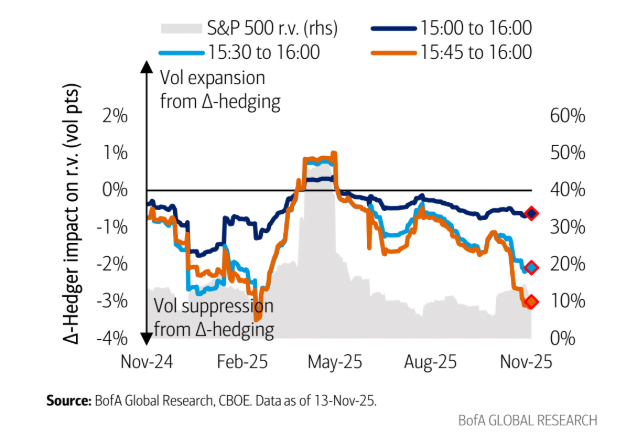
The exposure sits elsewhere. Equity volatility has been sold down to nothing: hedging demand has collapsed, asset managers are outright short VIX futures at historic extremes, and the crowded dispersion trade has left a large implicit short position in index volatility.
AI
Prices on AI-related stocks have gone up so much over time that the only way actually to justify keeping them and buying more is to assume that the eventual payoff will be much bigger and that AI will bring a once-in-a-generation productivity boom.
AI "working" is one thing, but it needs to be spectacular. Like actually SENSATIONAL. It needs to blow your mind every time on every new model release, because every step raises the bar for what has to come true.
Revenue has to inflect before spending peaks. Spending is going vertical. Revenue has to catch up. If it does, fine; if it won't, you get compute nobody's paying for right as the depreciation on all that hardware starts hitting earnings properly.
Right now, companies are building data centers on the assumption that demand for compute keeps climbing. Data centers take years to build, so the money gets committed now against a guess about demand 2-3 years out.
Every company guesses high. While yes, overbuilding wastes capital/money, but (big but) under-building could end up with the company that under-builds giving their customers away to the competitor, and the competitor might keep those customers for good. Faced with this trade, everyone errs big.
The catch is that each one sizes its buildout for a large share of the market, and they can't all have one. Add up 5 companies each building for a market they hope to dominate, and the total will be well past what anyone actually needs.
Well, and you can kinda think how that works out. The compute isn't as scarce anymore.
Billions in servers and chips don't hit that profit line when the money leaves, and accounting spreads the costs over hardware's expected life and a few years for this kind of gear. Cash is spent, but the earnings statement has only absorbed part of it. Reported profits look bigger than the actual spending would suggest.